


Alpacas Introduced




ALPACAS INTRODUCED
A beginner's intro to alpacas.
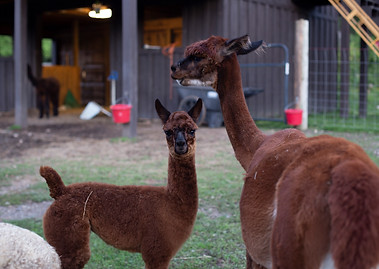
The alpaca (species name vicugna pacos) is a descendent from the wild vicuna, and is a species of South American camelid with two types originating from Peru, Bolivia, Ecuador, and Chile. The two types of alpacas are Huacaya (pronounced wah-key-ah), and Suri (pronounced sur-ee). Huacayas have a rounded, bulky appearance when they are fully fleeced, and have a signature "teddy bear" look. Their fiber grows perpendicular to the body, and is fine, crimpy, incredibly soft, and dense. Suri fiber lies parallel to the body in long-hanging, well-defined locks that grow towards the ground; these locks are extremely lustrous and silky to the touch. Around 85-90% of the alpacas found in the US are Huacaya.
ALPACAS VS. LLAMAS
What is the difference?
Alpacas have been specifically bred for their quality fleece for thousands of years, where llamas function as beasts of burden. Despite being in the same camelid family, llamas are significantly larger with denser bones, and have a more confident temperament. This makes them suitable for guarding other livestock and packing, easily carrying up to 30% of their body weight.


COLOR CLASSIFICATION
Understanding fiber classing.
While Peru classes up to 52 natural colors of alpaca fiber, the Alpaca Owners Association, Inc. (AOA) recognizes 16: white, beige, light/medium/dark fawn, light/medium/dark brown, bay black, true black, light/medium/dark silver grey, and light/medium/dark rose grey. Patterns found on alpacas are limitless! While not considered a color classification by the AOA, alpacas can also be classed as modern and classic greys, indefinite light, indefinite dark, pattern, pinto, fancy, and appaloosa; these labels are for animals that are participating in an AOA competition show and display one or more easily visible, distinct colors.
ABOUT ALPACA FIBER
Alpaca fiber: the superior natural textile.
Alpaca fiber is used to create high-end, luxurious garments and yarn, and can be felted for crafting and handwork. With a semi-hollow core, alpaca fiber traps warm air produced by the body both inside and between the fibers, making it up to ten times as warm as sheeps' wool. Alpaca fiber is smooth in structure, giving an extremely low "prickle" feel while also lacking the lanolin (wool wax or wool grease) found in sheeps' wool. Alpaca is naturally antimicrobial, moisture wicking, temperature regulating, and stays warm even when wet. Alpaca is flame resistant and meets the US Consumer Product Safety Commission's Standard as a Class 1 fiber for the use in clothing and furnishings.
An adult huacaya alpaca's shorn fleece typically weighs 6-10lbs and has three basic sections: the prime blanket (fiber from the back or "barrel" of the animal), seconds (fiber from the neck and upper thighs) and thirds (fiber from the legs, tail, and belly). Each section of the fleece has a purpose. The prime blanket is the highest quality and finest fiber, and is used for yarn or creating fabric. Seconds can be spun into courser yarn, which is typically used for items not worn on the skin (e.g., rugs, woven baskets, etc.). Thirds can be used for insulation, mulch in flower beds, or nesting material for birds. Seconds and thirds will also felt more easily for crafting projects. The use of alpaca fiber is only limited by your imagination!
ALPACA ANATOMY
A review of these majestic fiber animals.
Alpacas live on average 15-20 years but can reach into their mid-20s. Females, called hembras, typically weigh between 120-175lbs, where males, called machos, typically weigh between 140-200lbs on average. Standing at about three feet at the shoulder, alpacas are smaller in stature than their camelid counterpart llamas, and are bred for their fiber versus being beasts of burden (animals that are bred to guard other animals, or to carry loads for transportation). Domestic alpacas have been bred over generations to retain their fiber, and are shorn annually, with their fiber being harvested to knit or weave into textiles.
Alpacas have long necks that pivot with agility, blunted, cupped ears shaped like pickle spears, and large wide set eyes. As prey animals, these features allow the animals to efficiently survey for danger. Unlike hoofed horses, alpacas are two-toed ungulates and use the tips of their toes to sustain the bulk of their body weight when in motion. Unlike a true ruminant such as a cow, sheep, or goat (an animal with multiple stomachs that derives its nutrition from regurgitating and chewing partially digested food), alpacas are quasi-ruminants. Also called modified ruminants, alpacas have three-phase digestion (the rumen, reticulum, and one true stomach, the abomasum) instead of four stomachs. While alpacas have both top and bottom rear teeth, they have only bottom front teeth; the top is a hard dental plate that ideally lines up perfectly with those bottom front teeth. Alpacas use their bottom teeth and dental plate to collect food and move it to the rear of the mouth for mashing and grinding, using a figure-eight motion to chew. When alpacas reach maturity around 24 months old, males (and some females) grow canine teeth (also called "fighting teeth") located between the incisors (bottom front teeth) and the molars (back teeth); they are very sharp and need to be blunted by a professional. This is usually done during the shearing season by a shearer trained to grind the teeth down. Alpacas teeth do not need to be brushed or otherwise maintained as long as the animal's bite is well-lined up, and their mouth is healthy.
ALPACAS AND BREEDING
Creating the next generations.
Both males and females reach sexual maturity around two years of age. A female must be at minimum 18 months old and 2/3 of her overall body weight to safely carry and deliver a pregnancy (called "unpacking"), and can carry a pregnancy into their later teen years if healthy and in good condition. Females are induced ovulators, meaning that they require the act of breeding to ovulate an egg. Gestation for a female is typically between 335-355 days, though some can deliver sooner, or as late as up to 400 days. Crias (baby alpacas) are usually born without assistance and are able to stand and nurse shortly after delivery. While many pregnancies begin as multiples at conception, alpacas typically deliver only a single cria; surviving twin pregnancies are incredibly rare.

ALPACAS AND SPITTING
Understanding spitting in alpacas.
Alpacas chew their cud (partially digested food returned from the reticulum up through the rumen to the mouth for additional chewing), and they can and will spit. Alpacas typically spit at one another to assert dominance, to indicate that they are "closed" to a male attempting to breed (a pregnant or "closed" female will spit and kick at a male attempting to breed with them), to fight over food, or to defend their cria. Alpacas will not usually intentionally spit at people unless they feel threatened, though we do get in their way when they're spitting for other reasons!
KEEPING OF ALPACAS
The care and keeping of this low-maintenance livestock.
Alpacas are herd animals and do best in groups of three or more of the same sex. Male and female alpacas should never be housed together after weaning (when a baby no longer requires their mother's milk), due to the risk of accidental breedings. Gelded males (those who have been castrated) will still try to breed a female, which can result in uterine infections and ultimately infertility.
Alpacas are relatively easy to care for, however, new owners must research their keeping and care before joining the industry to ensure herd health. Visiting local alpaca farms, asking questions, and consulting with seasoned mentors are wonderful investments of time. General maintenance includes daily fresh, cool water in the summer months, and fresh, warm water in the winter months, access to fans for cooling in the summer months, constant access to quality, free choice grass hay, access to a maintained lush pasture, and free choice minerals designed for alpacas. Alpacas can also be supplemented with grain when they are pregnant or nursing, underweight, or not yet fully grown.
About ten alpacas can graze on one acre of maintained pasture. They are considered "gentle grazers" because of their padded feet versus hooves, and because they only nibble off the tops of grass versus uprooting it like a goat. In New York State, Alpacas require annual rabies vaccinations administered by a registered veterinarian. Because alpacas are susceptible to Meningeal worm (M-worm) carried by whitetail deer, they need a monthly Ivermectin shot, which can be administered by the herd owner. Beans (alpaca poop) should be removed from barns and paddocks daily to minimize parasite risks. Alpacas have nails that grow and need to be trimmed as needed.
Alpacas do not need to be brushed, but do require shearing (the removal of their fiber) once yearly. Ethical shearing is necessary to collect fiber and for the health of the alpaca; it does not hurt them. An experienced shearer can shear one animal in about five minutes, start to finish. Some alpacas with particularly full face fiber will require facial trims to prevent the animal from becoming fiber blind (the fiber growing over the eyes making it impossible for them to see).
While they can be skittish, alpacas are very easy to handle when compared to other livestock. They are incredibly intelligent and intuitive, and can be halter broken to lead, which makes their general care and keeping easier for handlers. A halter specifically designed for alpacas should always be used when leading, as they have a short snout with mostly cartilage and a high bone up near their eyes where the top of the halter (called a noseband) will sit. An ill-fitting halter can obstruct an alpaca's breathing and cause distress. Halters should not be left on an animal unless they are being handled, walked, or moved.

ALPACA FARMING IN THE US
Why are alpacas kept as livestock animals in America?
Alpaca breeding and farming, whether to produce top-quality seed stock animals or fiber animals, is an incredible lifestyle with strong income potential. Alpacas create a commodity that is both rare and in demand worldwide, and they are considered the "aristocrat" of all farm animals with their scrumptious fiber and charismatic manner. Alpacas are low maintenance, and live a relatively long and trouble-free reproductive lifespan with proper care.
Because all viable livestock models have a terminal market for animals that will not or should not be bred, there is a slow-growing market for alpaca meat. It is very high in protein and is a lean, flavorful red meat. Most alpaca farms in the US farm for championship bloodlines and quality seed stock (exemplary animals used for breeding) and/or for fiber.
Alpacas were first imported into America in 1987 from Chile, Bolivia, and Peru, due to US interest in the fiber market. Prior to this time, there were no protocols in place for the exportation of alpacas, but due to a complex mix of geopolitical and economic circumstances in South America - including significant terrorist activity in Peru – these three countries negotiated the necessary protocols to export animals to the United States, as well as Australia, New Zealand, Canada, England, and Israel. The US border was closed to importation in 2000 because some North American breeders feared that continued high volume of imports would oversaturate domestic markets with imported animals. The focus in the US alpaca industry became cultivating quality by breeding exemplary animals within both small farms and large scale breeders, and not importing additional alpacas. There are about 260,000 registered alpacas in the Alpaca Registry, Inc. (the ARI, once a subdivision of the International Llama Registry, was officially formed in 1995), with an unknown number of unregistered animals currently in the US.
There is a very active Alpaca Owners Association, Inc. (AOA) in the US that facilitates the DNA testing required to register an alpaca; they also certify alpaca competitions (also called "shows") all across America. DNA testing allows the AOA to assign registration numbers (ARIs) that accurately record lineage. This allows breeders to make informed decisions when choosing sires (males) and dams/maidens (females) for their breeding programs, based on desired and intended characteristics of offspring. Alpaca shows themselves are very similar to dog shows. Alpacas are separated by type (Huacaya or Suri), sex, age, and color. Experienced judges are able to compare the most similar animals with these classifications. Alpacas are judged 50% on the quality of their fleece and 50% on their conformation (the correctness of the alpaca's body). Fleece traits include brightness, uniformity, fineness, and organization to staple or lock. Winning ribbons adds value to an alpaca, as they confirm that animal's superiority to their peers.
For more information on the AOA, please visit their website here: https://www.alpacainfo.com/